Chapter 10: Playing Augmented Chords
Definition
An Augmented chord creates strong musical tension and is usually used briefly before resolving to another chord. It intensifies the sense of anticipation even more than a Dominant 7th chord. While often paired with a Dominant 7th, the Augmented can stand alone—for example, when transitioning from a 5-chord back to a 1-chord (NNS). It provides a sound that implies that your music playing is about to “go over a cliff” unless you quickly avoid that peril by voicing the next chord. Although an Augmented chord doesn’t have to be included with a Dominant 7th chord, it does add emphasis to the transition if quickly voiced in advance of that transition.
An Augmented chord is formatted by again altering the Major triad. It consists of the 1st, 3rd and sharped 5th tones of the chromatic scale. It is often referred to as an Augmented 7th, even though there is no 7th tone in it; it just sounds like it should be a 7th chord.
In the open-string position of the E9th tuning, an Augmented chord (or triad) is difficult to construct to include a sharped 5th tone while including the 1st and 3rd tones. With the use of pedals and knee levers, it is quite easy. A couple of the notes (dyads) could be used by pressing your A pedal a semitone halfway with open strings, but it is best to find a barred position for doing voicing an Augmented chord. Depending on the way this chord is used in a musical progression, a dyad may be all you need to emphasize the effect you are seeking at any given fret. That dyad would likely be just the 1st and sharped 5th tones at any selected fret position.
But there is the easy alternative. Engage pedals A and B, then engage your F knee lever (the fourth string raised a semitone). Also, if an Augmented chord can be further emphasized by a sliding-bar gliss up or down the fretboard every 4 frets (while voicing the same three notes at each stop) its effect is emphasized. It’s that grade-school math: an Augmented chord duplicates itself every 4 frets by providing another inversion of itself! The procedure seems complicated I know, but professionals do it with ease all the time, and you can too. Try it and listeners (and your band members) will view you as nothing short of a musical genius! Well maybe.
Note the Augmented tone (C) in the next Illustration and how it divides the E chromatic scale into 3 equal parts.

There are no other legitimate Augmented chords such as an Augmented 6th, 9th, 11th or 13th chords. When constructed, any tone within the construct can be assigned as the root tone among the three assembled tones. Although there are twelve augmented chords, the next demonstration will provide only those for the E-rooted chord, all being inversions of themselves.
Do note in the Illustration that follows. Besides the “easy” way I described how to quickly to voice an Augmented chord, the demonstrator also chose how to voice the chord using the half-raise of the A pedal, identified with the “h” beside the fret designation. Although you were provided my “easy way,” please do work on these other options, since an Augmented chord is usually expressed quickly, you may not have time to use the “easy way.”
Playing an Augmented Chord
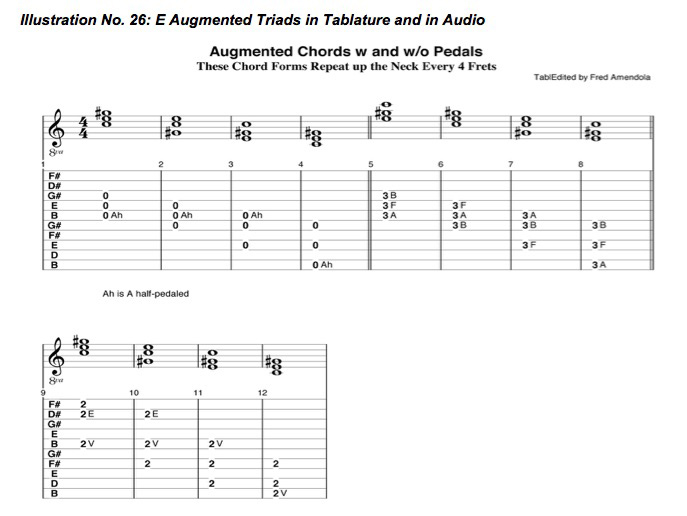 Click the triangle twice to play the E Augmented Triads as illustrated above
Rest and Cogitate on what you have just read, while listening to another great steel instrumental from an equally great player:
“On The Alamo” by S.G. Hall of Famer Pee Wee Whitewing
If you aced this Chapter I applaud your efforts. Maybe it’s a “downhill” run for the rest of the Chapters. But probably not quite yet!