Chapter 6: Memorizing the 15 Major Triads & Scales
An Annoying Reminder
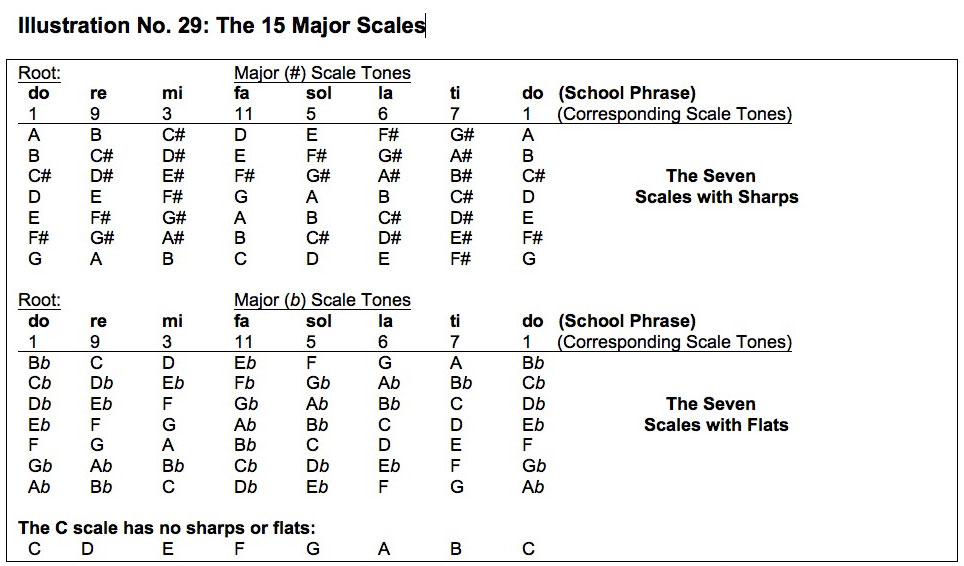
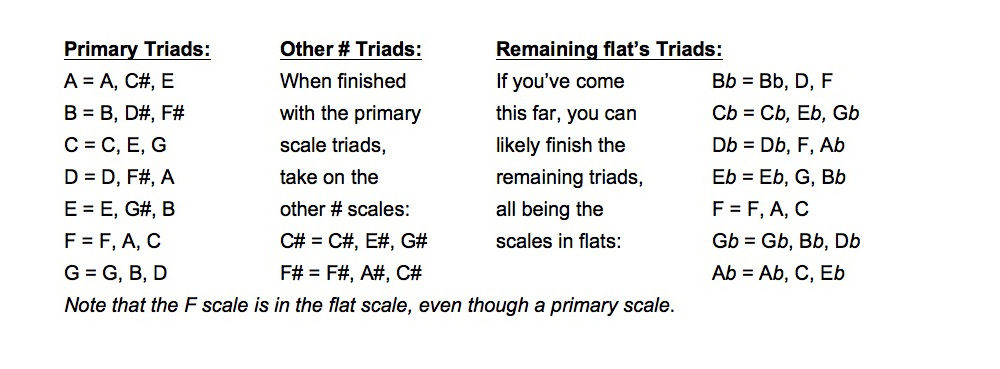
I pressed you earlier about memorizing every scale. I emphasized that if you could verbally “rattle off” all the notes in every scale you would be better able to determine any chord once you selected a root tone. Even better, if you could play every scale with the rapidity of Buddy Emmons you would probably be instantly hired by any band wanting a steel player as a member! I recognize that this would be an onerous task and take time well beyond the time needed to study the subject of this paper. So I’ll stop begging and can only hope that you choose to do it after being inspired by learning what is this Chapter (and beyond) provides. As a beginning, and to get you on your way, consider learning just the triads of the Major chords? Because of the use of the E scale in this paper, you already know one, the E Major triad (E, G# and B). Below are the 15 Major Scales. Following them are the Major triads I want you to learn before tackling the complete scales.
And about those triads, at age eleven, my steel teacher got me to memorize them for all the Major scales. He didn’t tell me why, but over the years since, they have proven to aid me in understanding chords, as well as writing this paper. I am certain that following that, my instructor would have had me memorize all the Major scales, but he never got around to it. I regret my family’s move to another town.
On the other hand, if such a ritual doesn’t interest you at all, close this Chapter and move to the next one and take a “Student’s Holiday” and return to me later on. We just have a number of Chapters to go and I want you back.
I’m Glad You’re Still Here
If you examine the listing of the scales, you will observe that they are formatted using sharped and/or flatted notes. For reasons unknown by this writer, in music, not all scales are written in sharps, nor are all scales written in flats. Then there are two that writers can use in either format, those being C# & Db and F# & Gb. Music is never written in A#, B#, D#, E#, G#, or Fb. Whatever key preference that a composer chooses for a composition is his choice to make, and it will be one of the 15 keys listed.
I’d like to get back to my desire that you learn all the notes in all the Major Scales. So, sigh and bite your lip, but continue reading. Select the C chord (which is the easiest to memorize because it has no sharps or flats in it). Recite its first seven letters (which are its tones). With each voiced note, you may actually be able to see the scale in your mind’s eye and know how each note positions itself in a Major scale. So, recite the C Major scale along with me: C – D – E – F – G – A – B – C. It was easy, wasn’t it? You’ve memorized one Major scale already, right? In your mind’s eye, “see” that between the 3rd and 4th tones there is no extra tone. And, between the 7th and 1st tones there is no extra tone. All the rest of the tones have a full tone of separation between them. Every scale you learn will have these same separations of semitone-change in their scales.
Because of my belief in your dedication to learning the construction of all the chords and because you’ve come this far in studying this paper (and you ain’t dead yet), I believe you know that after reciting the 1st scale tone of “C”, and when you voiced “D”, you will know that D is a 9th tone of the Major scale. When you voice “E”, you know it is the 3rd scale tone. In your “mind’s eye” you should be able to add the tones to each of those scale notes: 1st = C, 9th = D, 3rd = E, 4th = 11th, G = 5th, A = 6th, B = 7th, and finally, you are back to C. OK, I know it’s hard and you are probably thinking “It will take me the rest of my life to learn all 15 of them.” That may be true. But do remember this: you will also be learning how to play the pedal steel guitar for the rest of your life, so suck it up!
But think of what you’ve already learned about these scales: 1) Flat the 3rd tone gets you on track to create a minor chord; 2) Add a flatted 5th tone and you’ve created a Diminished chord. 3) Raise the 5th tone in a Major triad and you have an Augmented chord. 4) Flat the 7th tone creates a Dominant 7th chord. “Oh” you say, “We haven’t covered those unless I was asleep! You weren’t sleeping. But I did get your attention, didn’t I.
I’ll harp on: Since you are able to so easily learn the C scale, you could also learn all the other scales if you just memorized them. Consider the amount of confidence you would have if you could rattle off every note in every scale with ease. Heck, you would be well on your way to becoming the musical genius you always wanted to be. Not to forget, your spouse would have left you, and your kids would have grown up and left home. But you would still have your steel. So what’s the problem? Get with it. Take one scale each week and memorize it. Since you know how time flies, I know you could do it! You’ll be so proud of yourself in about 3 months that your next goal will be to memorize every lick that Buddy Emmons ever recorded…well, maybe.
Just begin with the Major Scale triads. As I said, if you committed to just one triad each week, you would be done within less than 4 months! So, I encourage you to start here, then trudge on with the rest of my driveling.
Break Time: Now take a break, maybe for a whole day before hitting the next Chapter. But before that, listen to the duo who captured a listening public to the sound of the steel guitar and led to Santo and Johnny Farina to becoming the most recorded duo in which the steel guitar was the lead instrument. You’re probably thinking “Tom’s going to put me to sleep with their signature hit, “Sleepwalk.” Keep in mind, Santo was 22 and Johnny was still a teenager when they recorded that tune. So, I’ll provide a similar tune, recorded quite sometime after that big hit. It reveals their advancement in musicianship.
“Teardrop” by S.G. Hall of Famers Santo & Johnny