Chapter 9: Playing & Identifying Minor Chord’s Sound
Review
Recall that in Chapter 8 I briefly touched on “tension-creating” chords when I described the 7th and 9th chords. Besides those chords, I mentioned that other chords create tension by “demanding” resolution to another chord. Other demanding chords are the Augmented and Diminished. They will be described in the next two Chapters. Of significance is the fact that a Minor chord can be either a tension chord or not one! Some songs and tunes can be played in their entirety in Minor chords. Buddy Charleton’s “Almost To Tulsa” comes close to an all-minor tune. Check it out in the Introduction of the “Tuning Tips & Topics” paper on this website.
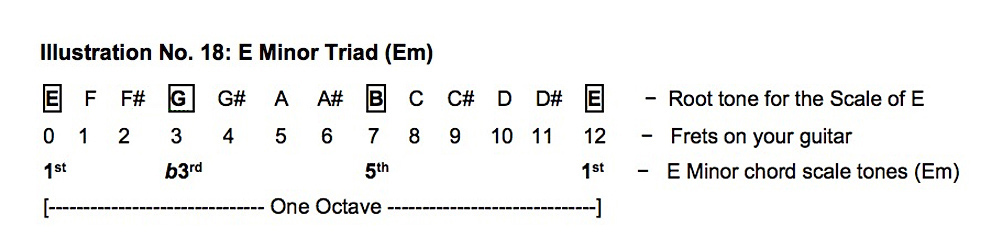
Observe the Illustration below. I know that you already understand that if the 3rd tone is flatted by a semitone, a Minor chord is created. Simple, right? View that below for the E chord:
Playing Minor Chords
On your E9th-tuned guitar, it isn’t possible to build an E Minor triad as an open-string chord. However, there are at least two other Minor chord triads that do exist in the open E9th tuning. The first is a B Minor chord. Simply pick the tenth string (B) which is the B Minor chord’s root tone, followed by the ninth string (D) which is the flatted 3rd tone, followed by picking the seventh string, which is the Minor chord’s 5th tone. The second voicing is also a B Minor, but is a different inversion, but requiring the engagement of the LKR (Eb to D) and picking strings 1, 2 and 4. If you wanted to get an inversion of the E Minor chord, you would need to place your tone bar at the 5th fret, then pick the same strings just mentioned. The main point of the discussion is recognizing how a Minor chord is formatted.
Before the creation of pedals and knee levers, players most often used forward bar slants to voice the Minors they wanted. Bar slants will not be a topic covered in this paper. But, when watching many older players perform, they still use bar slants and even reverse bar slants. That practice is surely “left-overs” from their lap steel days. Follow along with your guitar if you wish and duplicate the inversions of the E Minor chord at other fret positions and with pedal and knee lever employment.
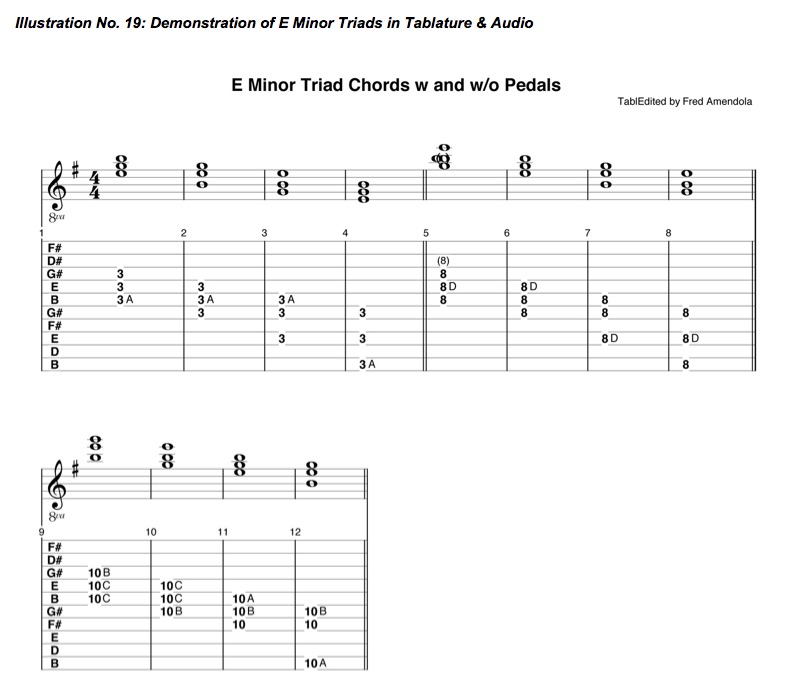 Click the triangle twice to play the E Minor Triad Chords as illustrated above
Playing Minor 6th Chords (Em6)
Everything continues to be simple. In this Illustration the subject is a Minor 6th chord. Observe this below:
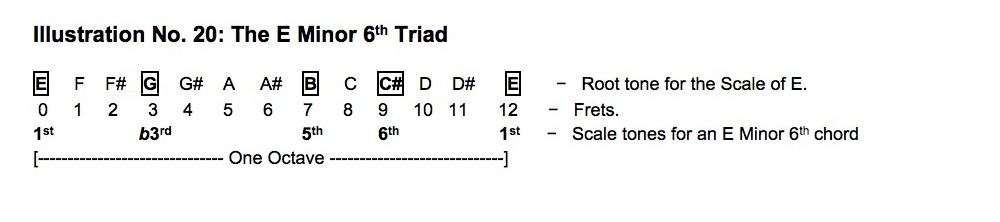
Simply adding the 6th tone to a Minor triad, creates a Minor 6th chord. That process is demonstrated in several of the examples in Illustration No. 21 that follows. Duplicate these with your guitar, as well as listen to them following your effort (or listen first, then duplicate them; it’s your choice). Isn’t my flexibility outstanding?
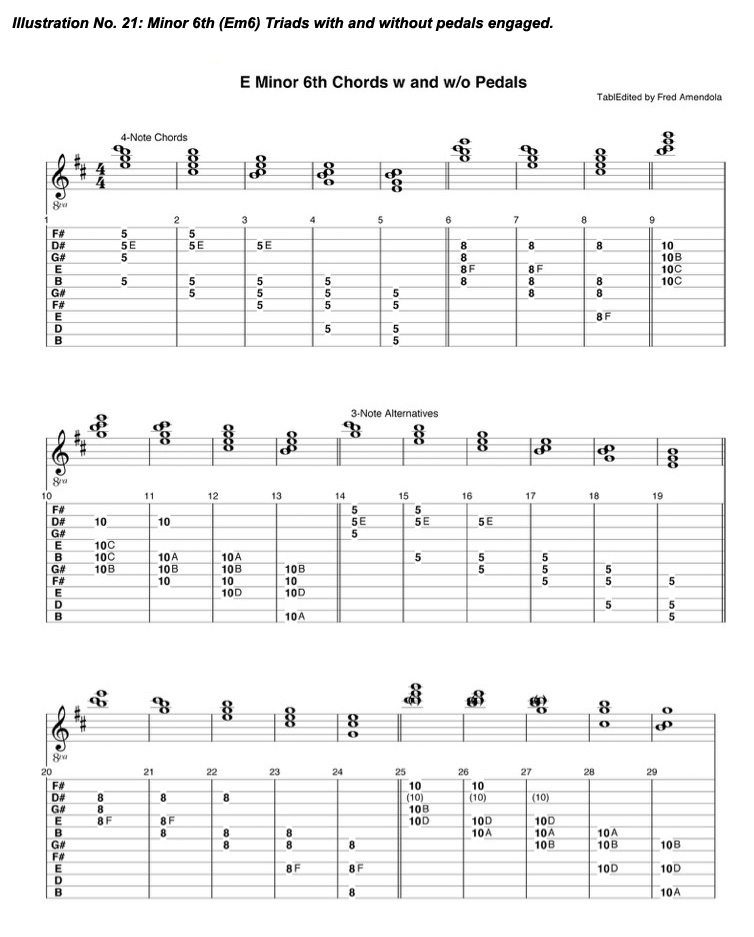 Click the play button (triangle) below to play the E Minor 6th Chords as illustrated above
Playing Minor 7th Chords (Em6)
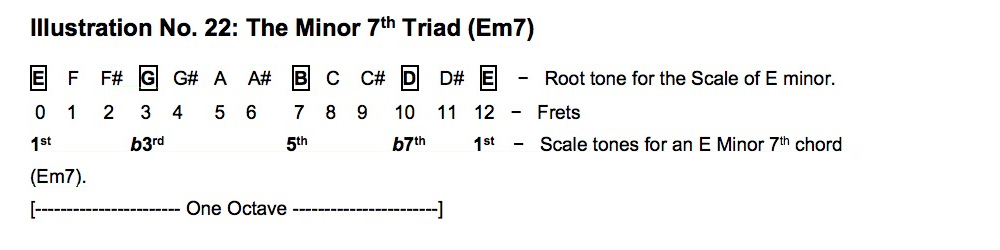
Do recall my previous mention that when depressing your A and B pedals (thus creating the A6th chord), that chord is also an inversion of the F# minor 7th chord. While maintaining those depressed pedal, and when placing your tone bar at any other fret also creates a different rooted minor 7th chord. Hey, you knew that, didn’t you?
In the next illustration, listen to the various voicings of the Minor 7th chord. Follow along on your guitar if you wish.
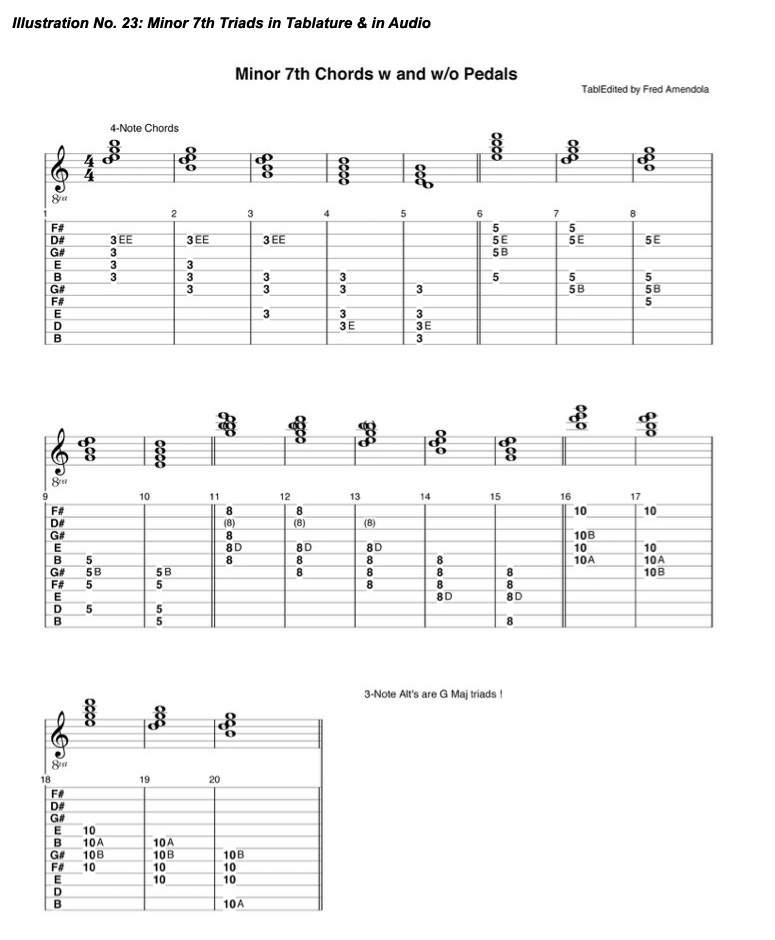 Click the play button (triangle) below to play the E Minor 7th Chords as illustrated above
Playing Minor 9th, Minor 11th and Minor 13th Chords
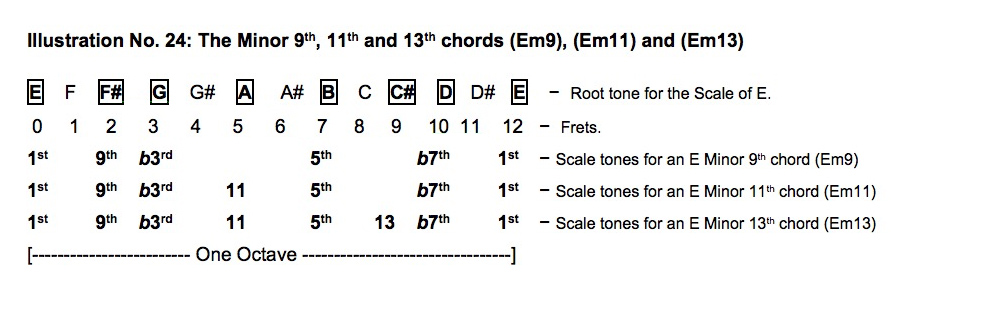
The pattern continues as usual, but I’ll not provide demonstration tablature. Besides their rarity, these chords contain many dissonant notes for our instrument (as well as many other chord-producing instruments), as to be deemed unnecessary to provide. Observe those dissonance problems in the Illustration that follows. It would become quite difficult to always avoid the dissonance between those adjacent-voiced notes. For convenience, these chords are often assigned different root tones but would still have those annoying dissonant tones unless such tones were separated by an octave (usually unavailable on the pedal steel’s tuning).
Let’s Take Another Break: This fellow is so good, I just had to provide two of his tunes:
“Don’t Get Around Much Anymore” by Gary Carpenter
“Poor Side of Town” by Gary Carpenter
How about this: You are half-way trough this paper. I commend you. Now; on to the remaining half, full speed ahead!