A Bit of History of a Chord-Producing Instrument
The Beginning Instrument: The Plectrum Guitar
The original acoustic guitar is alleged to have been brought to the Hawaiian Islands by Spanish and Portuguese sailors and so-called “Mexican Cowboys” in the late 19th century. They were constructed similarly to acoustic guitars existing today. In time, Hawaiians were able to import the guitars and even built some of their own. The natives took to this instrument with enthusiasm. But it would be many decades before the idea came to one of those islanders to turn it into a new instrument. It is reasonable to conclude that its original chorded tuning would begin with the same pitch as the first string on those guitars then and today.
Many 6-string tunings would be instroduced over the following decades by subsequent players; mostly Hawaiians and mostly with the first string being tuned to that E pitch. For a comprehensive history of tunings for the steel guitar, see History of Steel Guitar Tunings. Interesting stuff, but let’s get to the subject:
The Invention
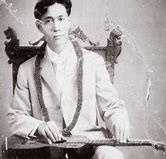 A young Joseph Kekuku
On one of the Hawaiian Islands in the 1880s, a native man named James Hoa showed some fellow musicians how raising the strings on a guitar and then fretting them with a “glass perfume bottle or a knife” created a very different sound from his acoustic guitar. Sometime later, he claimed to be the inventor of the instrument. Unfortunately for Hoa, and in particular, he didn’t do anything with his discovery. Thus, he never received credit for the invention. But his claim has lived on in some rare publications and Hawaiian lore. However, because very little exists about Hoa’s claim, it drives home the point that an idea not acted upon is an opportunity lost.
The Inventor: Joseph Kekukku
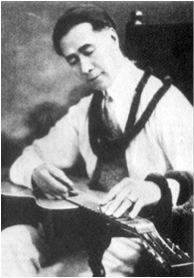 An adult Joseph Kekuku
Around 1884-86 at age 11, another Hawaiian, Joseph Kekuku, truly did something with his discovery, and likely had never heard of James Hoa. The story has had variations from Joseph and family members. The one I was told by the Oahu Music company is as follows: the young Joseph was walking along a railroad track on his way to school he accidentally dropped his guitar. As the guitar made contact against one of the rails, he heard a pitch-changing sound from the strings. An idea flashed in his mind that he immediately acted on.
He enlisted the help of his school’s shop teacher. They raised his guitar’s strings between its nut and bridge, installed metal strings, then fashioned a flat piece of steel to fret the elevated strings. That “piece of steel” ultimately gave the new instrument its name: “steel” guitar. Little “Joey” placed the instrument on his lap and thereafter learned to play it in that fashion, probably leading to its second designation of, a “lap” steel guitar. The tuning he allegedly created for it was the A Major (highest to lowest): E, C#, A, E, A, E.
Thereafter, Joseph dedicated himself to learning his newly invented instrument, becoming an accomplished player by the standards of that time, and solidifying his claim of inventing the instrument. At some point, perhaps when reaching adulthood, he formed a musical troupe and toured Hawaii and the U.S. mainland. He also said he invented the flat bar he used, for which he surely deserves credit.
Prior to Joseph’s invention, Hawaiian culture originated another guitar playing form in the early to mid-19th century known as “slack key”. This acoustic instrument embraced (even to this day) “open tunings” and is played in a conventional, finger-style manner, not like lap-style that required a slide bar as Kekuku had originated. These players typically tuned their guitars “down” a half-tone or more, hence the term “slack key.” There are over 50 different tunings that have been authenticated for these “slack key” players, and they gave little thought to the legitimate pitch of any tuned keynote [and what authority existed for determining the precise pitch of any string…the A-440 Hertz wasn’t even a thought back then]. For those interested in learning more about the “slack key” guitar, see Slack-key guitar – Wikipedia.
Much information is available on the Internet about Joseph. One interesting source is at Joseph Kekuku and the Steel Guitar (BBC Arena: American Epic). It provides one other slightly different version of little Joey’s invention. Incidently Joseph’s tone bar was a 1/4″ flat piece of steel with one rounded edge. It has lived on in the more sophisticated “Nick Manoloff” bar a bit more easier to hold (with its concaved side). It is mainly used today by resonator guitar players (Dobro, et. al.). See Nick Manoloff – Wikipedia for more history. Most future steelers have preferred a round bar; its exact appearance date being unknown.
The Momentous Event
At the time of the steel’s birth it remained relatively unknown outside of Hawaii. For the next quarter century, it was played almost exclusively for accompanying Hawaiian culture folk music there.
“Thank You Hula Girls:” Surprisingly, and in spite of the steel’s exposure in the States by several other touring groups, it failed to achieve much attention. That would change at San Francisco’s 1915 Panama Pacific Exposition, when promoters invited a group of Hawaiian dancers with their instrumental accompanists to attend that international event.
The presence of those “hip-swaying” girls and the plaintive sounds of this “new” guitar captured the eyes and ears of listeners and apparently the prurient desires of many of the hundreds of male attendees. Thereafter, those men surely recalled the echo of the steel’s melodious interpretations by those swaying hula girls from our country’s distant “Island Paradise.” They likely associated the music and those native Hawaiian girls with “romance” and definitely embraced the sound of the new instrument. That reaction prompted many Hawaiian groups to form and tour the mainland. When young men (the great Jerry Byrd admitted to me as being one) saw those hula-girls perform, accompanied by the added stateside name of “Hawaiian guitar,” they (and Jerry!) had to have one–the guitar that is, but all would have likely settled for one of the Hula dancers!
And in support of our instrument’s effect on one of man’s basic instincts, Jerry Byrd chose to record a song that tends to confirm those (and his) feelings.
“Keep Your Eyes on the Hands” by S.G. Hall of Famer, Jerry Byrd
Proliferation
A Company’s Help: The popularity of the steel’s sound led to the emergence of the Oahu Music Company and the “explosion” of their classes for steel-player wannabes throughout the country, I too being one of them. The great Herb Remington also revealed to me that he was one of their long-time students. Unfortunately, my parents moved from where I had been taking lessons, ending all instruction for me. But, I persevered on my own! That popular music company continued to provide instruction lessons well into the 1950s. [See Oahu Music Company – Wikipedia].
Thus, a music genre, whose introduction to North America began in San Francisco in 1915, would spread across the hemisphere. What began as the “Hawaiian” guitar (as Statesiders would call it then) would soon cross over into mainstream Hillbilly, Western Swing and ultimately labeled as simply “Country Music.” It even had an influence on a few of the “Big Bands” of the 1930’s and 40s. More recently the steel has found its way into Rock and Indie music.
Quest for Volume
The Dobro: When first used in musical groups of the 1920s, this open-tuned, 6-string lap steel received life by projecting its instrumental interludes to audiences, usually with the help of a microphone funneled through PA systems. However, the most successful effort to make these wooden-bodied steel guitars (pictured previously) louder was by John Dopyera (also pictured) and his brothers, Rudy, Emile, Robert, and Louis.
Their creation was played identically like lap steels of the day but utilized a metalized sound chamber consisting of three-layered aluminum cones called resonators. The name the Dopyera brothers likely intended for it is a mystery. However, the company’s name, being a contraction of their family name, was placed on the instrument’s headstock. Since it didn’t sound like any guitar built before that time, it quickly became identified as the “Dobro.” And who knows, that could have been the name they wanted for it all along. [Considerable information about their creation can be accessed at John Dopyera – Wikipedia.]
The Dobro definitely provided more volume than the wood-based Hawaiian guitar. But it sounded more like the resophonic guitar that it was, rather than any instrument with a complete wooden sound box. Other manufacturers soon came into being that used the newly coined word, “resonator,” to categorize their instruments, thus distinguishing their creations from the Dobro brand, but sounding quite similar.
Arrival of the Pickup: Around 1929 the guitar pickup was invented by George Beauchamp and Adolph Rickenbacher. Fortunately, and surprisingly, the instrument ultimately chosen to mount it on was the lap steel guitar, it being deemed the most in need of a volume increase. It took a couple of years before being mounted on a regular guitar. The Adolph Rickenbacher Company finally got around to mounting that pickup on a lap steel in about 1932.
It isn’t known what the name for the steel guitar was to be, but players quickly named it the “Fry Pan” for obvious reasons; hey, take a look at it! Replicas of the instrument are still being manufactured, but not under the Rickenbacker name. [Note the Company’s later spelling-change of their name as I have written it here, in the underlined company names.] That interesting story and much more about the company is at: Rickenbacker – Wikipedia.
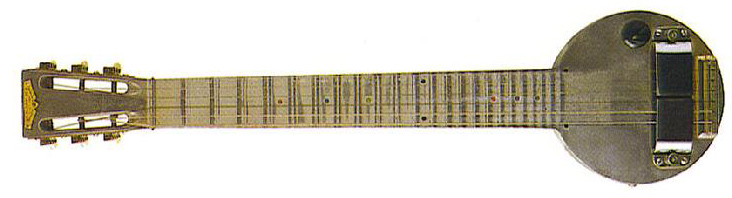
More Strings, More Tunings: As mentioned, the steel guitar began with 6 strings with an acoustic sound box, but played resting on the lap of the player. It was in the 1930s that some those lap steels appeared with 8 strings. The original and first steel with pedals arrived in the early 1930s and were 8-stringers (the MultiKord; discussed later here). Eddie Alkire introduced a slick 10-string lap steel (the Alkire Eharp) in the late ’40s. Rickenbacker also introduced a 10-stringer at about the same time. [If more information is desired about those two instruments, simply use the Internet Search option on your computer. The Steel Guitar Forum’s website also has a search option. Just type in “Alkire” and/or “Rickenbacker.” You can read considerable information about those guitars provided by fellow steel players.]
After the arrival of the MultiKord in the early ’30s, it would take a decade or more years for the 10- and 12-string pedal steels to appear. A 14-stringer was created in the 1970s, thanks to a fellow named Frank Miller of Ashland, Oregon. It didn’t gain traction. Julian Tharpe, the noted pedalist, did have a 14-string built for him by the MSA Company in the late 1990s. That was shortly before he passed away. There were likely others who experimented with 14-string steels, but those creations were not embraced by most pedalists.
The open tunings for those early lap steels still remain, but for the pedal steel, two 10-string tunings have ultimately provided significant versatility for altering the basic tuning for the likely purpose of constructing chords. The E9th was an expansion on several E-based tunings in the early 20th century. The close seconds were the A6th and soon after, the C6th. The A6th has nearly faded from use as a stand-alone tuning. However, and ironically, the most used portion of the development of the E9th tuning is its A6th side (when its A & B pedals are utilized together). However, the C6th has found a competitor in the emergence of the so-called 12-string “Universal E9th/B6th” tuning. The current tuning “winner” is the E9th and will be primary tuning for explaining chord construction in this paper.
Recommended Supplemental Reading: But before you begin the tuning-evolution story that follows, I strongly recommend that you read a very informative discussion of some history of the E9th tuning that was posted on the Steel Guitar Forum several years ago. That discussion was short, compared to this lengthy one. However, that discussion and is quite insightful: https://bb.steelguitarforum.com/viewtopic.php?t=149442.
Need for Chord Versatility
The MultiKord: It would be over 40 years from Kekuku’s discovery before someone got the idea to make the steel guitar more chord-versatile. That occurred in 1932, right after the Rickenbacker Company created their Fry Pan. The Harlin brothers (Jay (J.D.), Herb, George, Jimmy, and Wynn of Cincinnati, Ohio designed, built and ultimately patented their “chord changer” mechanism for the instrument they called the “MultiKord” (front-view pictured). Their chord changer altered the pitch of strings, permitting more than strum-chords on fix-tuned steels or 3-string grips for some melody lines. They Harlin brothers fashioned pedals to the instrument, added legs and built a solid body around it.
Before this time, players had been limited to delivering chords by selecting different string-grips of dyads, triads, Major, Minor, Augmented and Diminished chords at odd places up and down their steel’s neck. As mentioned, various tuning permitted that, as well as forward and reverse bar-slants at various fret locations. Those slants were mastered by almost all notable players. However, when needed beyond playing the melody of tunes, most players relied on their backup accompaniment to provide the proper “fill-ins” for the more complex chords.
Although those fill-ins were much easier to access with the MultiKord, the full potential and the concept of a “pedal” steel guitar didn’t catch on with main-stream players for nearly two decades to come.
The Big Band “Swing” Players
Bob Dunn: From the 1930s to the 1950s, “Swing was King” with the likes of Milton Brown and his “Musical Brownies.” Milton’s “Brownies” probably had the steel’s first jazz player, Bob Dunn. Bob wowed crowds and steel players wherever the group performed (mostly in Texas and adjacent States). Bob was the first to record with an amplified steel guitar. The Brownies recorded many 2-tune records, made available in recent years on multiple CDs (a boxed set).
The following features Bob Dunn, playing what was considered one of his “signature” tunes, but unfortunately only provides a hint of his talent, if all of the Brownies’ recordings are reviewed and Bob’s lead-work is revealed.
“Taking Off” by S.G. Hall of Famer Bob Dunn
Leon McAuliffe: The most recognizable Western Swing band following Milton’s untimely death in 1936 was Bob Wills’ “Texas Playboys.” Wills had been a member of Brown’s group (as a fiddle player). When he formed the Playboys, he soon hired Leon McAuliffe on steel. Leon soon became a household name, thanks to Wills’ frequent mention of his name when Leon took the lead on a song (such as Bob yelling, “Take it away, Leon“). Wills hired many steel players over his many years of performing and touring. They too were regularly identified on records and during live performances, ending up with nearly the same recognition as McAuliffe (Herb Remington, Bobby Koefer and many, many others). Wills and his Playboy’s are credited as having been viewed in person by more attendees at their performances than any musical group for the two-plus decades that Wills and his Playboys toured. As close as I ever got to that group in my playing days was backing up his famous singer, Tommy Duncan, for a one-night performance. But as a kid living on my grandma’s farm in Oklahoma in the ‘40s, I listened on a battery-powered radio to McAuliffe on Wills’ noonday KVOO radio broadcasts from the Cain’s Academy dance hall in Tulsa. Maybe that experience led me to the only instrument I ever chose to play.
McAuliffe worked at his art and developed his playing talent far beyond his early days with Wills. Following WW-2 he formed his own band, “The Cimarron Boys,” touring and recording from 1946 into the early ’60s. He never moved to pedals, always being a stand-and-play steeler, as well as an accomplished vocalist and frontman for his band. He and his band recorded the following tune in 1950. As you will discover, he kept Wills’ yelling phrase as revealed in the following tune. Learn more about Leon at Leon McAuliffe – Wikipedia.
“Take It Away, Leon” by Hall of Famer, Leon McAuliffe
Alvino Rey: There was one major “chord player” during the 1930s, ‘40s and early ‘50s, (the period known as the “Big Band” era). It was Alvino Rey. Rey would constantly voice big chord strums, even using those strums for melody leadwork in his huge orchestra. When I interviewed him in 1977 for an album issue in my Steel Guitar Record Club, he never mentioned playing a MultiKord, but did reveal his collaboration with the Gibson Company to create what they called the “Electraharp.” Learn more about Alvino at Alvino Rey – Wikipedia. The picture is a rare one of him, his orchestra and his original Electraharp. The fellow behind the steel wasn’t its player. Alvino is on the far right with the baton. When more modern pedal steels arrived, Alvino tried many of them (as pictures of him reveal). During my visit with him, he had an MSA Classic upside down and was in the process of altering his pedal-pulls.
About The Electraharp: This steel guitar with pedals was introduced in 1938. But Gibson soon found itself in legal trouble with the Harlin brother’s patented “chord changer” mechanism on their MultiKords. Gibson either lost that lawsuit or bought their way out of it. Regardless, it was settled.
Gibson then proceeded to alter their own chord changer mechanism to get around MultiKord’s design-patent and continued building their Electraharps. But neither their guitar nor the MultiKord was popular with mainstream steel players, and the only music written for it was by the Harlin boys at their school in Cincinnati, Ohio. As previously mentioned, for years they taught scores of students, using the school to promote sales of their guitars to those students or anyone else. The pedals on Gibson’s Electraharps were clustered at the left end of their guitars, exactly as Multichord had placed theirs.
Look closely at the two models of these Electraharps. Notice that the changer-end and tuning-head end on the guitar (Left picture) are reversed, as compared to most steel guitars built back then or today. That reversal could be true of the guitar to the right, but the nice rosewood or walnut tuning-key and changer-head cover-pieces prevents their viewing, thus unknowable. Also observe the pickups. A different style for each. Those might have been modifications by subsequent owners, but we may never know that either. Check out their beautiful curly maple cabinets!
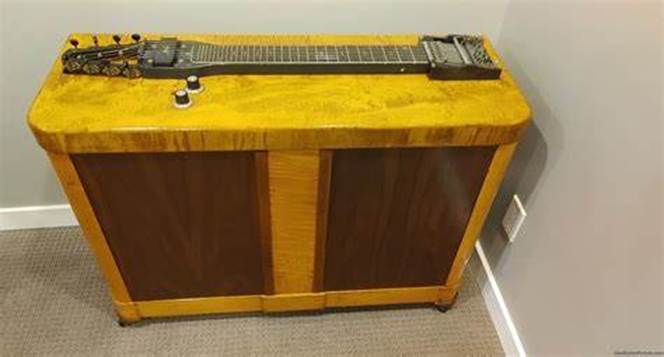 Front side of the Electraharp
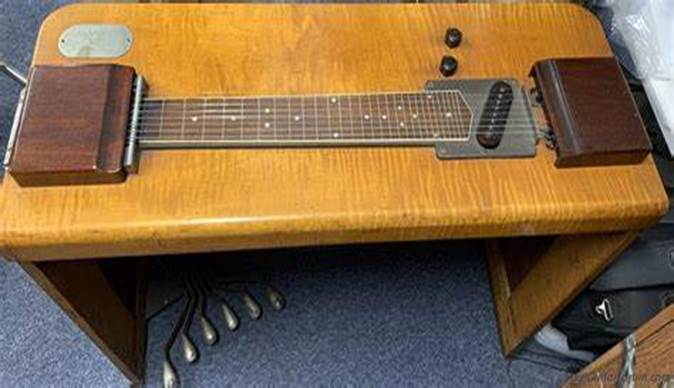 Player’s side of the Electraharp
Considerable information exists on the Internet about the Gibson company and their Electraharp, but has to be accessed in bits and pieces from the many listings.
Jerry Byrd and His C6th and Diatonic Tunings
But still, most steelers couldn’t wean themselves from at least two necks, believing that two were needed to accommodate the E9th “Country” players and the “Western Swing” A6ers. Then came Jerry Byrd’s emergence in the late ‘40s and for the next 30 years. The facility he demonstrated, style and deceptive simplicity became hugely popular with his instrumental recordings and backup with so many vocal artists, Hank Williams in particular. With his 7-string C6th tuning creation (with the E string as the first string on his 7-string Rickenbacker), and his “quickly changeable diatonic tuning (from bass to treble: D, E, F, G, A, B, C, E), he proceeded to record the most steel albums of all time (other than the Farina brothers after recording their mega-hit, “Sleepwalk.” Neither the Farinas or Byrd played a pedal steel, and the Farinas were just a couple of “splash in the pan” pop-music players as far as the Country players were concerned, but all did learn “Sleepwalk!” For more on Byrd’s diatonic tuning, see: Jerry Byrd’s C Diatonic Tuning.
Jerry Byrd’s influence prompted some steelers to remove their “Western Swing” A6th tuning, replacing it with Byrd’s C6th. As time passed and with most “Swing” players discovering that simply adding a G-tuned string above their then E-tuned string on Byrd’s C6th tuning, the C6th easily replaced their need for the A6th tuning’. [Of note is the recent replacement of that G string with a D-tuned string, adding a 9th tone to their C6th 10-string neck.] And with the 10-stringers being built at that time, there was plenty of room for that extra string and even the addition of an F-tuned string in the ninth string position on that C6th neck. It served as some interesting F-rooted chords. Those string-additions still accommodated their Swing music just fine and Byrd’s style as well. Also, it functioned remarkably well for Jazz as Buddy Emmons demonstrated when touring and particularly with his recording of his “Steel Guitar Jazz” album a few years into his lengthy career. [As an aside, when the Jerry Byrd Fan Club sprung up, Buddy was one of the original members. I too became a member as soon as I heard of the Club’s existence!] Listening to Jerry’s signature tune was enough to make him our “Musical Hero” for the rest of our lives.
Give a listen to Jerry Byrd’s signature instrumental:
Steelin’ The Blues by S.G. Hall of Famer Jerry Byrd
With that, the C6th finally won out, actually being standardized in pedals and knee levers before the emerging E9th neck. I still wonder when a single-neck pedal steel, with a 12-string universal tuning will replace both the E9th and C6th necks. [See: https://en.wikipedia.org/wiki/Universal_tuning.] With the Universal tuning’s extra pedals (usually five), it effectively combines the two tunings, thus making the pedal steel guitar a standardized, single-neck instrument. On the other hand, it might limit its potential for further advancement by continuing as an “ever-changing” musical instrument.
But still today, many steelers want double-neck guitars, believing that two are needed to accommodate the E9th “Country,” “Swing” “Jazz” and whatever musical genre it enters.
So, The Non-Pedal Steelers Plodded On
Most steelers weren’t impressed by either the MultiKord or the Electraharp and their chord-changers, mainly choosing to play multi-neck rigs with the tunings they preferred. Like scores of others, I was one happy kid in 1950 at age 15 to give up my 6-string all-metal Rickenbacker that I had played for 4 years, when I convinced my parents that I needed a triple-neck 8-string Fender “Stringmaster” (model). I had learned that during songs, the so-call “neck-hoppers” would jump between string-banks in order to voice the chords they needed, such chords being more accessible with multiple-tuned necks. Noel Boggs (pictured) was the master of this technique, while perfecting those options with his own quad Stringmaster. I wanted to be a neck hopper too but was a very poor one.
Give a listen to one of Noel’s signature instrumental:
“Little Coquette” by S.G. Hall of Famer, Noel Boggs
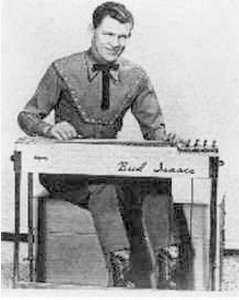 Bud Isaacs with his Bigsby
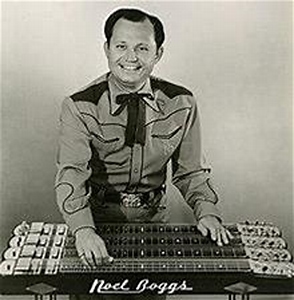 Noel Boggs with his quad Fender
Modernization
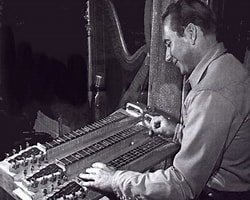 Joaquin Murphey
Joaquin Murphey: It wasn’t until the ‘40s in Los Angeles that Paul Bigsby built his first pedal steel for that area’s Country-Jazz player, Joaquin (pronounced Wah-keen) Murphey (pictured). “Murph,” as his friends called him, may have been the first to show Western Swing steel players what could be accomplished on a pedal steel if chords were mixed with the hot jazzy single-string improvisations that he was celebrated for delivering. Bigsby, in addition to offering a simpler chord changer than either MultiKord or the Electraharp, chose to place the guitar’s pedals in a row between the front legs of the steel he built for Murphey, the first to play a Bigsby, but a host of steelers followed with purchases.
In the mid-90s I interviewed Murphy. He proved to be a difficult interviewee by moving away from my questions with little continuity on any subject. Not to criticize his demeanor, I just should have let him talk, drifted back to the topics I wanted to cover and kept asking questions. I could have later gathered those bits and pieces and assembled his responses in meaningful order. On that occasion I ran out of time, a mistake I’ll always regret. Murph was obviously Curly Chalker’s role-model, since Curly’s playing style became similar to Murphey’s, and even advancing its delivery even greater. Curly was also like Murph, as confirmed by by many, showing a lack of patience, temper flair-ups and social distancing (something I never experienced when interviewing Curly or when producing two of his albums. He did get miffed at me when I tricked him into revealing his copedents to me back when I had my column with Guitar Player magazine. But that’s another story. But let’s listen to what Murphey could do on the steel that led to what so many up-and-coming greats gained from him.
“Undecided” by S. G’ Hall of Famer Joaquin Murphey
Back To Bigsby
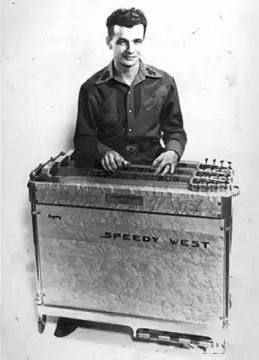 Speedy West
A host of major and developing players soon began acquiring Paul Bigsby’s creations, including Maurice Anderson, Speedy West, Bud Isaacs and Joaquin Murphey, the latter being the first. Owning a Bigsby was nearly a “claim to fame” by the great players tht followed.
Even with all the pedals, most steelers still couldn’t give up their multi-neck rigs, with each neck having different tunings, such as the E7th, E13th, A6th and A Major High-Bass. Most steelers were not yet captivated by the new chord-producing pedal designs coming from the few builders in existence at that time. So they kept thinking they needed those extra necks.
In the late ’40s and the ‘50s, builders had moved to “8-stringers” (observe that in the pictures). Many players began upgrading, me included. Also, Western Swing groups were jumping on the “wagon” of the “Big Band’s” popular musical sound. Notable Western Swing bands included Spade Cooley, Ole Rasmussen, and Cliffie Stone. They copied the swing bands, but with more stringed instruments than the horns, woodwinds and percussion instruments of the “pop” swing bands of that time. Other than Alvino Rey, the “Western” swing bands chose to include the steel guitar. Those players included Murphey, Boggs, Herb Remington, Pee Wee Whitewing, Leroy Honeycutt and Speedy West, to mention a few. I’ll have much more about Speedy in a future Chapter. Those bands mentioned were mainly concentrated in the Los Angeles area and the States of Texas and Oklahoma. Interestingly, more Hall of Fame steelers were born in Oklahoma; perhaps meaningless and coincidental, but an Oklahoma City newspaper made a big deal about it in an article, even contacting me for input (probably because I was the only living Hall member and was born in Oklahoma), but who knows?
Break Time: Give a listen to a fellow who played in Hank Thompson’s “Brazos Valley Boys” and many other notable groups. His first name was obviously a nickname, attributable to his size, but he was a monster player. More information is available about Whitewing on the Internet.
“On The Alamo” by Hall of Famer Pee Wee Whitewing.
Knee Lever Origin
Zane Beck: I have to give some credit to Zane Beck (of ZB and BMI guitar-building fame) for adding knee levers to the pedal steel. However, when I interviewed him he didn’t claim to have been the first to add them to any steel guitar, other than his own. His reason for the additions was brought about by a band leader’s refusal to hire him if he played a steel guitar with pedals. Zane said he circumvented that prohibition, and the band leader never asked him to explain what those “things” were that hung from under his steel. Regardless, knee levers began to appear on many pedal steels by many builders. And when Zane began building his ZB guitars, knee levers were on it. So maybe Zane was the first to add them to a pedal steel, but definitely not to a lap steel. Much information exists about Zane at Zane Beck – Wikipedia.
The First Steel with Knee Levers and a Wrist Lever, The Harmolin? Many years ago. I happened to acquire an interesting Harmolin acoustic steel guitar (pictures to follow). My model was a 7-stringer, but with some puzzling attributes that I will get to shortly. I recently searched the Internet and found some information about the company; see Harmony Company – Wikipedia. It appears that the firm was established sometime in the 1930s. I suspect that they also produced regular 6-string models of Spanish plectrum guitars, but the only pictures I could find about them revealed their 7-string “Hawaiian” model that they introduced in about 1938.
Before viewing my Harmolin, first observe the 7-string tuning-key headstock (second down picture) from the Internet. Below it, observe the seventh string’s nut piece that has been “out-boarded,” extending beyond the guitar’s neck to accommodate the out-boarded 7th string. Of particular significance is the presence of the two left-knee levers. Both have adjustments for tuning the pitches of selected strings but not appearing to be changeable to alter any of the other strings’ pitches. Look back again at the first picture and observe that the bridge piece is wide enough to accommodate all seven strings. My Harmolin doesn’t have that widened bridge piece (and I’ll get to that momentarily).
In the pictures, it is impossible to see the “Patent Pending” words that are pressed into the knee levers’ chrome-plated hardware, but are embossed on my model. Also included is the word, “Hawaiian.”
Now, contrast the Internet pictures with my 7-stringer (right-side photos). Strangely, the nut is of normal width, even though the headstock was milled for 7 strings, but with the extra string squeezed between the 3rd and 4th strings. Next, the bridge width is for a 6-stringer, but with a “palm” (or “wrist”) lever also squeezed between the 3rd and 4th strings there. To accommodate that string, the wooden nut piece has been cut about half-way through, with the lever’s arm extending under three strings to reach that string. Although hard to see, and amazingly, the end of the lever has a roller affixed to it for smoothly raising that extra string to the desired pitch. The roller is a remarkable addition and reveals that the person who added it was aware of the probable abrasion to that string, with the likewise probable result, string-breakage. An adjustment (an Allen-head set-screw) on the lever allowing for tuning it to the proper pitch, either for a semitone or a full tone raise (the maximum pitch raises available on that string).
The lever’s construction appears to be a bit better than being called “home made,” but I’m confident that it was added by someone who once owned it, not done at the maker’s factory. Interestingly, among the pictures from the Internet, no such lever was shown or even referenced as an add-on accessory. But perhaps some such pictures exist of this lever from other sources, but I doubt it.
In the left-sided photos, note that one knee lever is folded, apparently to affirm that both levers folded to allow the guitar to be housed in its case. Observe that the tuning adjustments for the knee levers are positioned between the nut and the tuning key head. It makes no sense to me why the guitar’s neck (from the headstock to the nut) wasn’t widened on both guitars, particularly since the model with the out-boarded nut has a full-sized 7-string bridge. So why not just widen the neck and omit the out-boarding? My model doesn’t have a widened bridge, prompting me to believe it was originally built as a 6-stringer. But then if so, why does it have a 7-key headstock?
Enough of this. Let’s get back to some more history:
The Pedal Gliss Explosion
Right after WWII, and for the next 10 years, what had been described as Hillbilly music began to merge with the more sophisticated arrangements of Western Swing and a newer emerging sound called “Country/Western.” In years to come, the C/W label would lose the word “Western” to just become “Country.”
Then in 1954, a major event occurred. The tune “Slowly” was recorded by Country singer, Webb Pierce. He had hired Bud Isaacs (previously pictured) as the steel man for that recording session. With that tune, the pedal steel guitar got its start as an even more dynamic contributor to Country Music’s sound. His accidental recording of the “pedal gliss” (a term I used in my writings for Guitar Player magazine) and stereotyped the steel guitar as the “Country” sound, even to this day. The “gliss,” created by a pedal steel guitar was unique because it required no movement of a player’s tone bar when voiced as a tone within a musical phrase or chord. [Note: For the more complete story of Isaacs’ accidental creation of the pedal gliss, read, Digression No. 2: Bud Isaacs & The Pedal-Gliss in my “Tuning Tips & Topics” paper on this website.]
From that pivotal moment and event, steel guitarists across the United States began incorporating the E7th tuning into their instruments. To replicate Isaacs’ signature glissando, players assigned a dedicated floor pedal that raised the ir second string B, to C#, and their third string G# to A. Prior to that change, the common tuning for the 8-string pedal E7th-tuned steel, from highest to lowest pitch, had been E, B, G#, E, D, B, G#, and E. These modifications marked the beginning of several significant changes that soon followed.
The First Major Change: Addition of the F# String
The first major alteration to the E7th tuning appears to have been made by Jimmy Day. Buddy Emmons, told me that Jimmy added the middle E string between the G# and E strings on his 8-string E7th tuning. I think Buddy was simply confused when he told me that, because the middle E string had been inclujded in the E7th tuning for years. The actual addition I think Buddy was referring to was the F# string, which was quickly embraced by other players. This change raises the question of which lower string was removed to accommodate the new F#. But apart from that, I believe that Jimmy Day should receive credit for creating the E9th tuning in its rudimentary format.
The Second Major Change: The High G# String Addition
The next significant modification was introduced by Ralph Mooney, who added a high G# using a thin banjo string. This addition was aimed at achieving “chordal finality,” such as a transition from an E7th chord to a root chord of A, where the logical finishing note would be an A in the top string position. Mooney provided this by adding a G# at the top of his E9th tuning, raising it to an A when the appropriate pedal (just the one pedal) was engaged. While it didn’t occur to me to ask whether this required a three-string pull on one pedal. Regardless, the new sound gained popularity, and prominent players, including Emmons, quickly adopted the high G# string. This also brings up the question of which string was eliminated to make room for the addition, especially since most pedal steels at the time were 8-stringers. By that time, however, Emmons had a 10-string steel, allowing for greater flexibility, but the tuning was still not fully complete.
The Third Major Change: Addition of the F# and D# Strings
During his time touring with Ray Price and the “Cherokee Cowboys,” Emmons found himself unable to sleep on the tour bus and began pondering how to capture the chords and riffs forming in his mind. He ultimately concluded that adding a couple of additional scale tones — a D# (Major 7th tone and an F# (another 9th tone) — could be the answer. Buddy had the bus driver pull to the side of the road. He retrieved his steel guitar from the cargo compartment and returned to his “cubbyhole” bunk and began experimenting with scales, imagining the chords and riffs he could create if he added those additional strings. Having already graduated to a 10-string steel (with the first string tuned to Mooney’s high G#), he decided to install an F# and D# string in place of two rarely-used bass strings he had previously installed in the ninth and tenth string positions. He removed those two lower strings and replaced them with the higher F# and D#.
At that time, Buddy was regarded as a playing innovator, although widespread recognition as the foremost player was still ahead for him. His innovations with the pedal steel were being swiftly adopted by his growing number of admirers, many eager to learn his tuning and pedal “setup,” a word used long before being called a “copedent.” At the time, Buddy had formed a loose partnership with resonator-player Shot Jackson, calling themselves “Sho-Bud” steel guitars. After returning to Nashville, he and Shot reconfigured the guitar, moving the new strings-tones above the high G# string for easier access. Because of Buddy’s touring, recording and stellar steel playing, “Sho-Bud” immediately experienced a surge in their guitar-building business, providing 10-string pedal steels that included the F# and D# strings at the first and second string-positions. [Note: The pitches of those two bottom strings are a bit of a mystery, but revealed in the next paragraph.]
Later on, when I re-released Buddy’s famous “…Jazz” album as a two-disc set, I had six tunes tabbed by Bob Grossman, a buddy who replaced me in a band in our high school days. One tune from the second disc was selected from a group of single-recordings Buddy had made during his early years of playing. In preparing the tablature Bob discovered that Buddy’s rendition of “Flint Hill Special” was recorded on his E9th neck and had his ninth and tenth strings tuned to a low G# and E respectively. In order to tab that E9th tune accurately, those two strings had to be there to play the low register riffs Buddy voiced on that tune. Buddy never mentioned the presence of those strings in the musical biography I included on his “…Jazz” album jacket, even though we had several interviews to complete it and Buddy knew the older recordings that would be on the second disc included with that package. Since then, no one has ever brought that to my attention. But Buddy was notorious for constantly experimenting with his tunings. It appears that in the beginning he was wanting his more penetration of the bass clef, but changed his mind when he decided on the two higher-pitched strings (the F# and D#) to the first and second string-positions on the E9th tuning.
The Fourth Major Change: Pedal and Knee Lever Assignments
The evolution of the 10-string E9th tuning required decisions about which strings would be altered by the floor pedals. Most of these choices were made by Buddy Emmons, except for the specific floor positions. Emmons decided to split the B and G# strings, which had previously been actuated by a single pedal, establishing the current “A” and “B” pedal changes. In a phone call to Jimmy Day, Emmons shared what he had done but omitted details about their side-to-side positioning. That omission led to the “Day versus “Emmons” floor-positioning preferences that players adopted. The origin of the “C” pedal remains unclear, as Emmons did not elaborate on it, but he likely selected those changes as well, given his influence.
Emmons was likely responsible for recommending the pitch changes for the knee levers chosen by Sho-Bud customers, as nearly every other modification (including those on the C6th tuning) has been attributed to him. Achieving recognition as “The Foremost Steel Guitarist” of his day, Buddy wrote and recorded (1971) a unique tune, using many of the sound effect pedals he was using up to that time. Here is an example that gives new meaning to the word, amazing:
“Witches Brew” by Buddy Emmons
The Mislabeling
Quite soon after Emmons added the F# and D# strings to the then-current 8-string E9th tuning, players were curious as to what to call it, initially dubbing it the “inside/out” tuning. Dewitt “Scotty” Scott (the producer of the International Steel Guitar Conventions in St. Louis, Missouri for many years took on the “task” by referring to it as the “chromatic” E9th in his course books that were published by the Mel Bay Company. The tuning had only one “chromatic” string-connection existing in the chorded tuning, that being the second string (D#) and the forth string (E). That hardly qualified the whole tuning to be labeled chromatic. There were a few other chromatic-connecting strings available, but knee levers and/or pedals had to be employed to create those connections. Many players referred to the first and second strings as the “chromatic strings.” Regardless, and for close to a decade, “non-chord-understanding” steelers quickly adopted this mislabeling. Fortunately, that identification title for the tuning has disappeared from most steel guitarists’ lexicon.
The Pedal Steel’s Unique Attributes
While all musical instruments share the capability of producing musical sounds, there are several distinct categories that I believe separates the pedal steel guitar apart from those other instruments. I know of 5 of those unique attributes. Perhaps readers here can think of others. If so, alert me. Here are my five:
1. Most percussion instruments can play only one single note: drums, timpani and a few others that are more obscure. Then there are the brass instruments, the woodwinds and several others that can play all the single notes of scales, but only one note at a time. The steel guitar (lap or pedal) obviously, can play as many notes as there are guitar strings and in multiple scale pitches.
2. Some instruments can produce full, rich chords: pianos, accordions, various keyboards, guitars, harps, and most string instruments. There are surely some others. The pedal steel can do that too, but with the added capability of voicing duplicate-pitched strings. The common E9th copedent, displayed in upcoming Chapters and with its complement of pedals and knee levers, can provide duplicate-pitched notes of F#, G#, C#, D#, and E in the open-string position and at in any other rooted pitch in the open-position as well as by barring any fret above that open-string position. Naturally, this is achieved by employing pedals and knee levers available in the basic E9th. If I’ve missed other such duplicate notes, it doesn’t matter. The fact is that its copedent provides those options.
3. The major identifying sound of the steel guitar is the “pedal gliss” and bar slides. Such slides can span several octaves, with perfect fluidity and sustain (thanks to our volume pedal). I don’t know of another instrument that can duplicate that, even with a foot-volume pedal. Some might mention the harmonica with its “comb” feature (a mechanism positioned on the harmonica’s end), which increases the pitch of notes and is manipulated by the player. However, it doesn’t do it while other notes are still voicing, nor with fluid harmony from each note-change. Thus, the pedal steel wins out.
4. The steel guitar can be tuned to a Just tuning, while achieving fully blended chord voicings in many chords and keys. I know of only one other instrument that is Just-tuned: the harmonica just mentioned. But once its basic key is changed, the player must swap it for a different keyed harmonica to continue playing as a Just-tuned instrument. No other instrument that I know of can change from one chord to another (as the pedal steel can) and still achieve the blended chords of a Just-tuned instrument. Granted, some chords created are not always in tune with the Just scale, but plenty of Just-sounding chords are possible. And not to overlook the fact that the use of a tone bar can “true” the Just-tuned voicings at the will of the player. If anyone knows of a non-electronic instrument that can achieve multiple Just-producing chords, let me know and I’ll eat my words.
5. Few, if any instruments other than the pedal steel can create and provide chords without the player’s movement to other frets or positions on their instruments. Think about it; how many stringed instruments can create chord-voicings using only a player’s knees and feet while picking the same strings? To reveal this, I’ll restrict the discussion to just three strings (matching the same number of picks typically on a player’s hand). There are additional chords if I listed others that exist, but the examples here are enough to make my point.
While voicing strings 4, 5 and 6 of the E9th tuning’s strings:
Open E9th string 4, 5 and 6 (E, B, G#) = E Major chord; the basic inversion.
Engaged A pedal: (E, C#, G#) = 3 notes of the E6th chord, and 3 notes of the C# Minor chord, but has enough notes available in the remaining complement of E-chorded strings (if the second and ninth strings are not voiced), to qualify as an E13th chord.
Engaged B pedal: (E, B, A) = 3 notes of the A9th chord but also referred to as a suspended chord.
Engaged A and B pedals: (E, C# A) = 3 notes of A6th chord and 3 notes of the F# Minor chord.
Engaged RKL lever A & B pedals: (D#, C# A#) = Three notes of the C# Dominant 9th chord.
Engaged RKL lever and A pedal: (D#, B, G#) = 3 notes of the C# Dominant 9th chord, absent the 7th tone.
Engaged RKL lever and B pedal: (D#, B, A) = 3 notes of the C# Dominant 7th chord.
There could be other chords to mention, but that isn’t the point for revealing this remarkable characteristic of the pedal steel guitar, creating chords without changing to other strings or fret positions.
If readers can think of other attributes of the pedal steel that are unique to it, let me know and I’ll add them here.
The Final E9th Chapter?
As previously discussed, the sound of Isaacs’ pedal gliss quickly became identified with Country Music. But the instrument’s potential would subsequently exceed expectations, invading Rock music, with “Sneaky Pete” Kleinow and Jeff “Skunk” Baxter (of “Steely Dan” fame), leading the way. However, Isaac’s accidental voicing of the pedal gliss deserves enormous credit for advancing steel’s popularity (mentioned previously with a link to the story). The gliss emphasized the fact that one or more voiced notes could change in pitch (by pedal and/or knee lever action), while other voicing strings could remain unchanged in pitch, thus permitting the fluidity of movements into and out of chords without a break in the musical flow by requiring other selected notes. The results of that advancement, and the musical innovations by its players then and thereafter, vastly broadened the steel’s appreciation from a listening public.
The acceptance of the gliss as a musical expression of the steel guitar, quickly became so great that pedal steel “garage-builders” sprung up across the country. The talent of existing players and the interest from “newbies” proved to be a huge boost to the steel’s recognition and popularity. Players since then have obviously found many ways to dramatically expand its use beyond what Isaacs recorded. Furthermore, the listening public seemed absorbed by the gliss-sound, viewing the steel guitar as the birth of a new instrument, and an American creation.
With that, the “Pedal“ Steel Guitar had finally established itself in the world’s music lexicon.
…Music Break. Please rest your eyes and dream of reaching the musical greatness of Joaquin Murphey.
“Sweet Georgia Brown” by S.G. Hall of Famer, Joaquin Murphey
You probably feel that this has been a “fun read” up to this point. That is over. It now becomes a serious study, requiring your attention and above all, dedication. Approach each Chapter as a lesson that you had to pay for. If you paid for it, you would take the attitude, “I don’t want to waste my money, so I’d better learn this.” Don’t get in a hurry. Commit yourself to absorb and even memorize wherever you can, no matter how long it takes. Perhaps devote a week of periodic reading to each Chapter. If your mind begins to wander, stop and come back at another time. If you just rush through this paper to get it over with, you will have defeated yourself and I have wasted my time providing it for you. …Tom